Learn what is digital marketing, how it works, its main types, benefits, and examples. Discover how SEO, social media, ads, and content grow businesses online.
What Is Digital Marketing?
Table of Contents
ToggleIntroduction
Today, when someone wants to buy a product, find a doctor, compare courses, book a hotel, or choose a restaurant, where do they usually look first? The internet.
That is where what is digital marketing becomes an important question for every modern business owner.
Digital marketing is the process of promoting products, services, or brands through digital channels such as search engines, websites, social media, email, online advertisements, and other internet-based platforms.
Think about a local bakery. Earlier, the owner might have depended mainly on banners, flyers, or word-of-mouth referrals. Today, the same bakery can appear on Google, post attractive reels on Instagram, run local ads, collect customer reviews, and send offers through WhatsApp or email.
In simple words, digital marketing helps a business reach the right people at the right time through digital channels.
What Is Digital Marketing and How Does It Work?
So, what is digital marketing in practical terms?
It is not simply posting on Instagram or running Google Ads. It is a complete marketing approach where different digital channels work together to attract potential customers, build trust, generate leads, and increase sales.
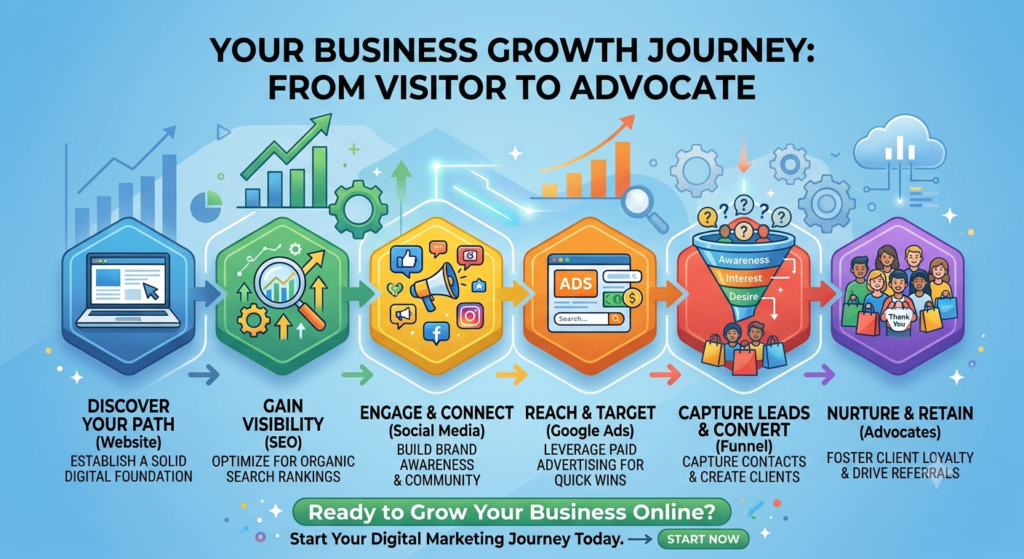
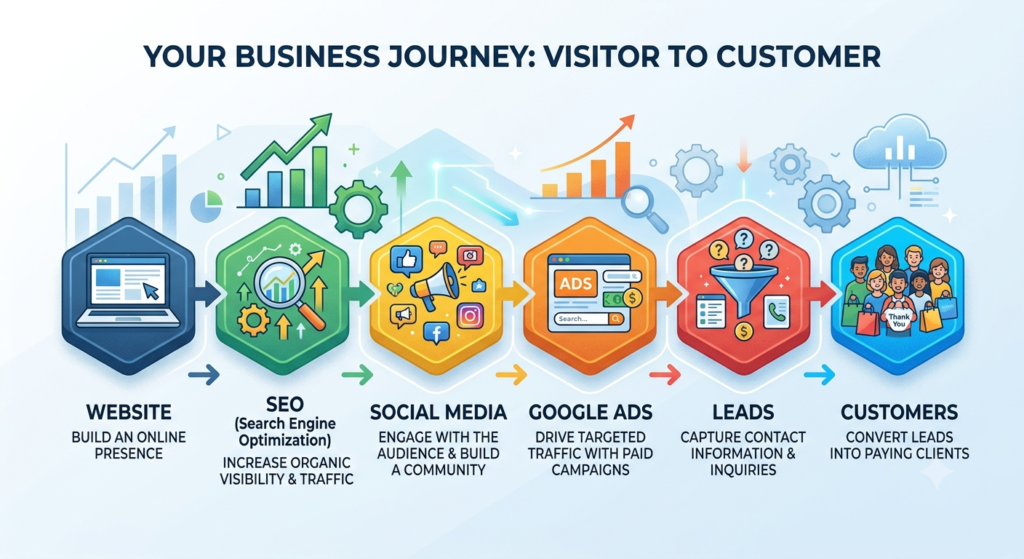
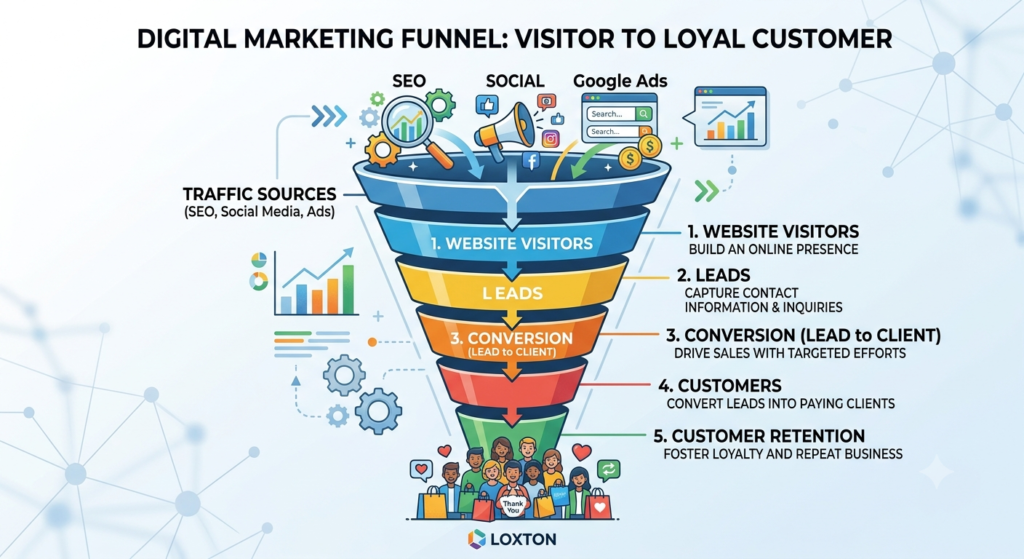
A typical digital marketing journey looks like this:
Awareness → Interest → Consideration → Conversion → Retention
For example, imagine a person searching Google for “best digital marketing course in Pune.”
They may first discover a training institute through an SEO-optimized blog. After visiting the website, they might check the institute’s Instagram page, read reviews, compare courses, and eventually fill out a contact form.
Different marketing activities have played a role in that journey.
A simple example
Suppose Rahul owns a small fitness studio.
He could:
- Create a professional website.
- Optimize it for local SEO.
- Publish useful fitness blogs.
- Post workout videos on Instagram.
- Run Google Ads for people searching for gyms nearby.
- Collect leads through a landing page.
- Send follow-up emails or WhatsApp messages.
- Encourage satisfied customers to leave reviews.
That is digital marketing in action.
What Is Digital Marketing? Main Types You Should Know
There isn’t just one type of online marketing. Businesses normally combine several methods depending on their goals, audience, budget, and industry.
1. Search Engine Optimization (SEO)
SEO helps a website appear higher in unpaid search results.
For example, if someone searches for “digital marketing agency in Pune,” businesses want their website to appear when that search has commercial value for them.
SEO generally involves:
- Keyword research
- On-page SEO
- Technical SEO
- Content creation
- Internal linking
- Local SEO
- Authority and backlink building
You can explore Digital Grow Online’s SEO services to understand how SEO can support long-term organic visibility.
2. Social Media Marketing
Platforms such as Instagram, Facebook, LinkedIn, and YouTube allow businesses to communicate directly with their audiences.
Social media can be used for:
- Brand awareness
- Community building
- Customer engagement
- Lead generation
- Product promotion
- Reputation building
The key is not to post just for the sake of posting. Content should give people a reason to stop scrolling.
3. Pay-Per-Click Advertising
PPC advertising allows businesses to pay for targeted advertisements across platforms such as Google, Facebook, Instagram, and YouTube.
For example, a dental clinic may run Google Ads for searches related to “dentist near me.”
The advantage is speed. Unlike SEO, which generally takes time to build, paid campaigns can start bringing relevant traffic soon after launch.
Digital Grow Online also provides PPC advertising services.
4. Content Marketing
Content marketing focuses on creating useful information that attracts and educates an audience.
This can include:
- Blog posts
- Videos
- Infographics
- Guides
- Case studies
- Social media posts
- Website content
Good content doesn’t constantly shout, “Buy this!” Instead, it answers questions and builds confidence.
5. Email Marketing
Email marketing allows businesses to communicate directly with subscribers and customers.
Businesses can use email for:
- Welcome messages
- Offers
- Newsletters
- Product updates
- Lead nurturing
- Customer retention
For example, an online store might send a welcome email after someone signs up and later recommend products based on their interests.
6. Website Development
Your website is often the place where digital marketing efforts finally come together.
A person may discover your business through Google or Instagram, but the website can influence whether they contact you, make a purchase, or simply leave.
A good website should be:
- Mobile-friendly
- Fast-loading
- Easy to navigate
- Secure
- Clear about its offer
- Designed around conversions
Digital Grow Online offers website design and development as part of its digital services.
Why Is Digital Marketing Important for Businesses?
Now that we understand what is digital marketing, let’s look at why businesses invest in it.
1. Reach a Specific Audience
Traditional advertising can be broad. Digital platforms allow businesses to target audiences based on factors such as location, interests, search behavior, demographics, and online activity, depending on the platform.
For a local business, this can be extremely useful.
A restaurant in Pune doesn’t necessarily need to advertise to people across the entire country. It can focus its efforts on people who are more likely to visit.
2. Measure Performance
One major advantage of digital marketing is measurement.
Businesses can track metrics such as:
- Website visitors
- Leads
- Clicks
- Engagement
- Conversion rate
- Cost per lead
- Return on advertising spend
Instead of simply asking, “Did our advertisement work?”, marketers can look at data and make better decisions.
3. Build Brand Trust
People rarely buy from a business they don’t trust.
Useful blogs, informative videos, positive reviews, social media activity, and a professional website can gradually establish credibility.
This is particularly important for services where customers need confidence before making a decision.
4. Work With Different Budgets
Digital marketing can be adapted to different business sizes.
A small business may start with local SEO and organic social media content. Another company may invest heavily in Google Ads, Meta Ads, content, SEO, and email automation.
The important thing is to match the strategy with the business objective rather than blindly copying competitors.
How to Create a Digital Marketing Strategy
Understanding what is digital marketing is only the first step. The real challenge is creating a strategy that makes sense for your business.
Step 1: Define Your Goal
Start with one clear objective.
Do you want:
- More website traffic?
- More leads?
- More online sales?
- More app installs?
- Better brand awareness?
- More local customers?
Without a clear goal, marketing activities can quickly become a game of “post and hope.”
Step 2: Understand Your Audience
Find out who your ideal customer is.
Ask:
- What problem do they have?
- What are they searching for?
- Which platforms do they use?
- What influences their buying decision?
- What objections might stop them from purchasing?
The better you understand the customer, the easier it becomes to create relevant marketing.
Step 3: Select the Right Channels
You don’t need to be everywhere.
For example:
Local clinic: Local SEO + Google Ads + reviews + social media
E-commerce brand: SEO + Meta Ads + Google Ads + email marketing
B2B company: SEO + LinkedIn + content marketing + email
Choosing the right channel is more important than trying to use every channel.
Step 4: Create Useful Content
Content should answer real customer questions.
Instead of writing a generic article titled “Our Services,” a business could publish content such as:
- “How Much Does Website Development Cost?”
- “SEO vs Google Ads: Which Is Better?”
- “How to Choose a Digital Marketing Agency?”
- “5 Ways to Generate More Local Leads”
This type of content can attract people who are already looking for solutions.
Step 5: Measure and Improve
Marketing is rarely a one-and-done activity.
Check your data regularly. Identify what is working, what isn’t, and where customers are dropping off.
Then improve the strategy.
What Is Digital Marketing vs Traditional Marketing?
A common question is how digital marketing differs from traditional marketing.
Traditional marketing includes channels such as:
- Television
- Newspapers
- Radio
- Billboards
- Print advertisements
- Brochures
Digital marketing uses online channels such as:
- Search engines
- Websites
- Social media
- Online advertising
- Video platforms
The biggest difference isn’t simply “online versus offline.” Digital marketing generally offers more granular targeting and measurable interactions.
For instance, a billboard may reach thousands of people, but you may not know exactly how many noticed it or took action.
With an online campaign, marketers can often see impressions, clicks, conversions, and other performance indicators.
That doesn’t mean traditional marketing is useless. The best choice depends on the audience, industry, location, objective, and budget.
Common Digital Marketing Mistakes to Avoid
Even a well-funded campaign can struggle when the basics are ignored.
Mistake 1: Focusing Only on Traffic
More visitors don’t automatically mean more customers.
A website needs relevant traffic and a clear path toward conversion.
Mistake 2: Ignoring the Website
You can run excellent advertisements, but if your website is slow, confusing, or difficult to use, potential customers may disappear faster than you can say “conversion.”
Mistake 3: Expecting Instant SEO Results
SEO is generally a long-term activity. Digital Grow Online notes that paid campaigns can show quicker results, while SEO and organic growth commonly take around 3–6 months.
Mistake 4: Copying Competitors
Your competitor’s strategy may work for their audience but fail for yours.
Study competitors for insights, but build your strategy around your own customers and goals.
Mistake 5: Not Tracking Conversions
Clicks and impressions are useful, but businesses ultimately need meaningful outcomes.
Track actions such as:
- Form submissions
- Phone calls
- Purchases
- Bookings
- Sign-ups
- Qualified leads
Frequently Asked Questions
What is digital marketing in simple words?
It is the process of promoting a business, product, service, or brand using digital channels such as websites, search engines, social media, email, and online advertising.
Is digital marketing useful for small businesses?
Yes. Small businesses can use local SEO, social media, content marketing, Google Ads, and other channels to reach relevant customers without depending entirely on large traditional advertising campaigns.
What are the main types of digital marketing?
The major areas include SEO, social media marketing, PPC advertising, content marketing, email marketing, affiliate marketing, and other online promotional methods.
Is SEO part of digital marketing?
Yes. SEO is one of the major components of digital marketing. It focuses on improving a website’s visibility in organic search results.
How long does digital marketing take to show results?
It depends on the channel and objective. Paid advertising can produce traffic and leads relatively quickly, while SEO and organic content usually require consistent effort over a longer period.
Can a business do digital marketing without a website?
It is possible to use social media or advertising without a website, but having a professional website can give a business greater control over its online presence and provide a central destination for potential customers.
Conclusion
So, what is digital marketing? At its core, it is about connecting businesses with people through digital channels in a useful, measurable, and strategic way.
From SEO and social media to Google Ads, content, email, and websites, each channel has a different role. The goal isn’t to chase every new platform or marketing trend. It is to understand your customers, choose the right channels, provide genuine value, and continuously improve based on results.